
 Services
 Conditions We Treat
 Contact
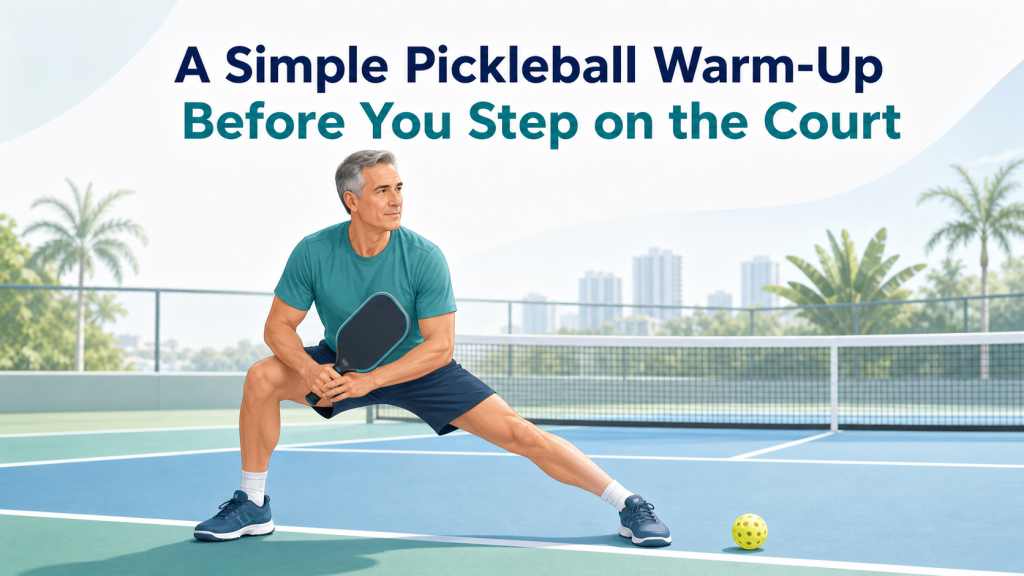
A simple pickleball warm-up should prepare you for quick starts, side steps, low reaches, paddle swings, and repeated changes of direction. Before the first hard point, spend about eight minutes raising your temperature, moving the ankles, hips, trunk, and shoulders, then rehearsing actual court movement. If you play regularly or are returning after an injury, sports rehabilitation can help you build a warm-up around your mobility, strength, and playing schedule.
You do not need a long list of complicated drills. The most useful routine is one you can remember, repeat, and gradually increase. It should leave you feeling alert and ready to move, not tired before the game begins.
Start with two minutes of easy movement. Spend two minutes on the ankles and hips, two minutes on the shoulders and trunk, then two minutes rehearsing pickleball footwork and controlled shots. Begin slowly and increase the speed only when your body feels ready.
Why pickleball deserves a warm-up
Pickleball may use a smaller court than tennis, but the body still has to react quickly. A short rally can include a split step, lateral shuffle, sudden stop, forward reach, trunk rotation, and several rapid paddle movements. Those demands arrive quickly when the first game starts.
A review of pickleball injuries describes strains, sprains, and fractures among the injuries seen in players. A warm-up cannot prevent every injury, but it can give you time to check how your body feels and gradually prepare for the movements ahead.
The goal is not to prove how flexible you are. The goal is to improve readiness. That means increasing body temperature, moving through useful ranges, turning on the muscles that control the ankles, knees, hips, trunk, and shoulders, then practicing the patterns the game actually requires.
A simple eight-minute pickleball warm-up
This routine is organized into four phases. Spend about two minutes on each phase. On a stiff morning, after a long drive, or before a more competitive match, you may need a little longer.
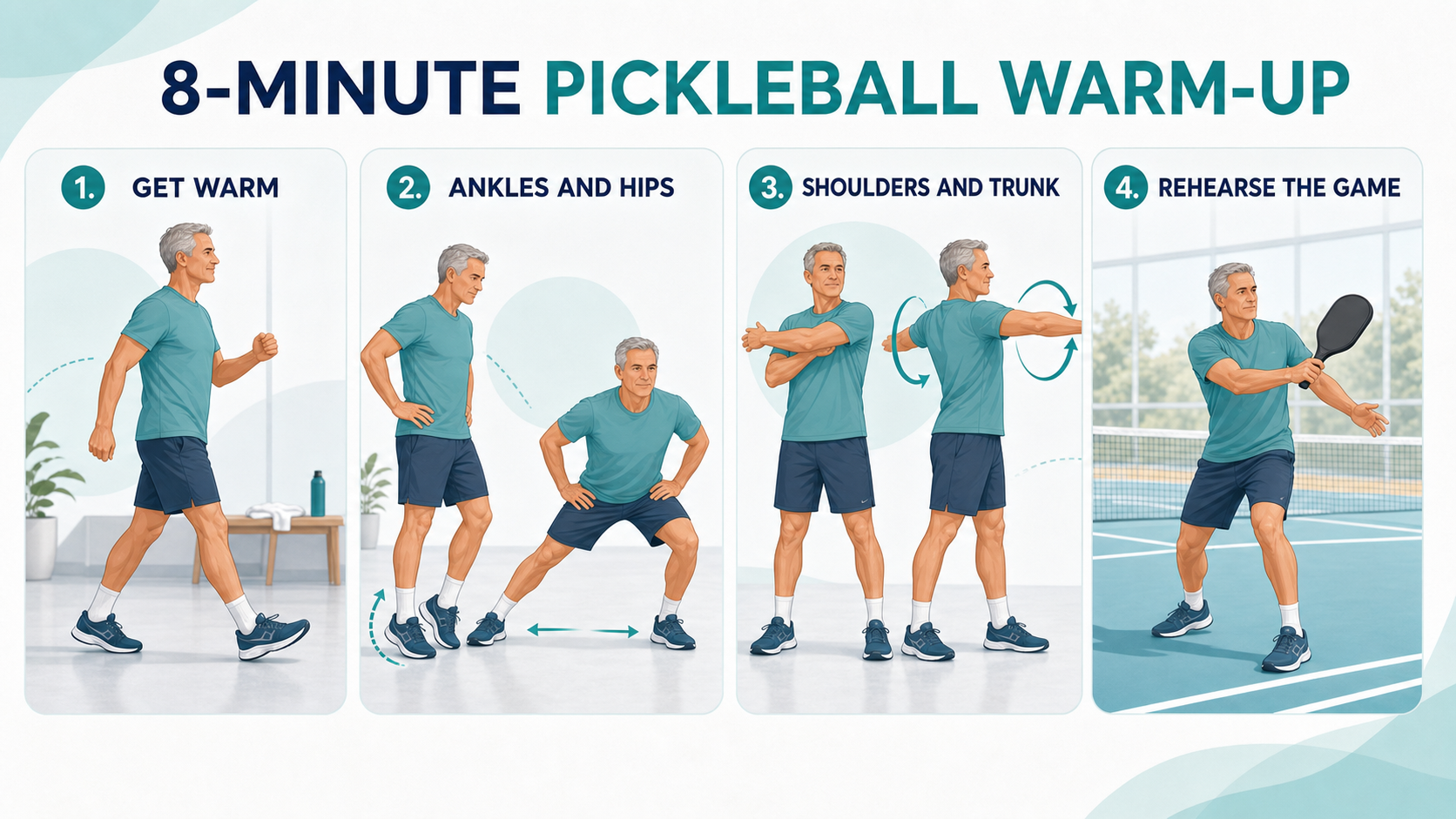
Minutes 0 to 2: Get warm
- Walk briskly around the court or parking area.
- Add an easy march with relaxed arm movement.
- Take several controlled side steps in each direction.
- Gradually increase your pace without turning it into a workout.
Minutes 2 to 4: Prepare the ankles and hips
- Rock the knees forward over the toes while keeping the heels down.
- Perform 10 to 15 controlled calf raises.
- Use 4 to 6 shallow lateral lunges on each side.
- Finish with small side shuffles in both directions.
Minutes 4 to 6: Move the shoulders and trunk
- Make small arm circles, then gradually make them larger.
- Turn the ribcage gently from side to side while the hips stay relaxed.
- Practice slow forehand and backhand shadow swings.
- Open and close the hand, then make easy wrist movements without forcing the range.
Minutes 6 to 8: Rehearse pickleball
- Practice two or three relaxed split steps.
- Shuffle toward an imaginary ball and return to a balanced position.
- Use a few controlled shadow dinks, volleys, and serves.
- Begin hitting softly before increasing pace or reach.
Many players warm up their shots but not their movement. Three easy dinks may help your touch, but they do not prepare your calves and hips for a sudden run toward the kitchen line. Give your feet and legs their own preparation before the paddle work begins.
Prepare your ankles, calves, and hips
Pickleball movement is often short and lateral. The calves help with the first push, the ankles control how the foot accepts the court, and the hips help you reach without collapsing into the knee or low back.
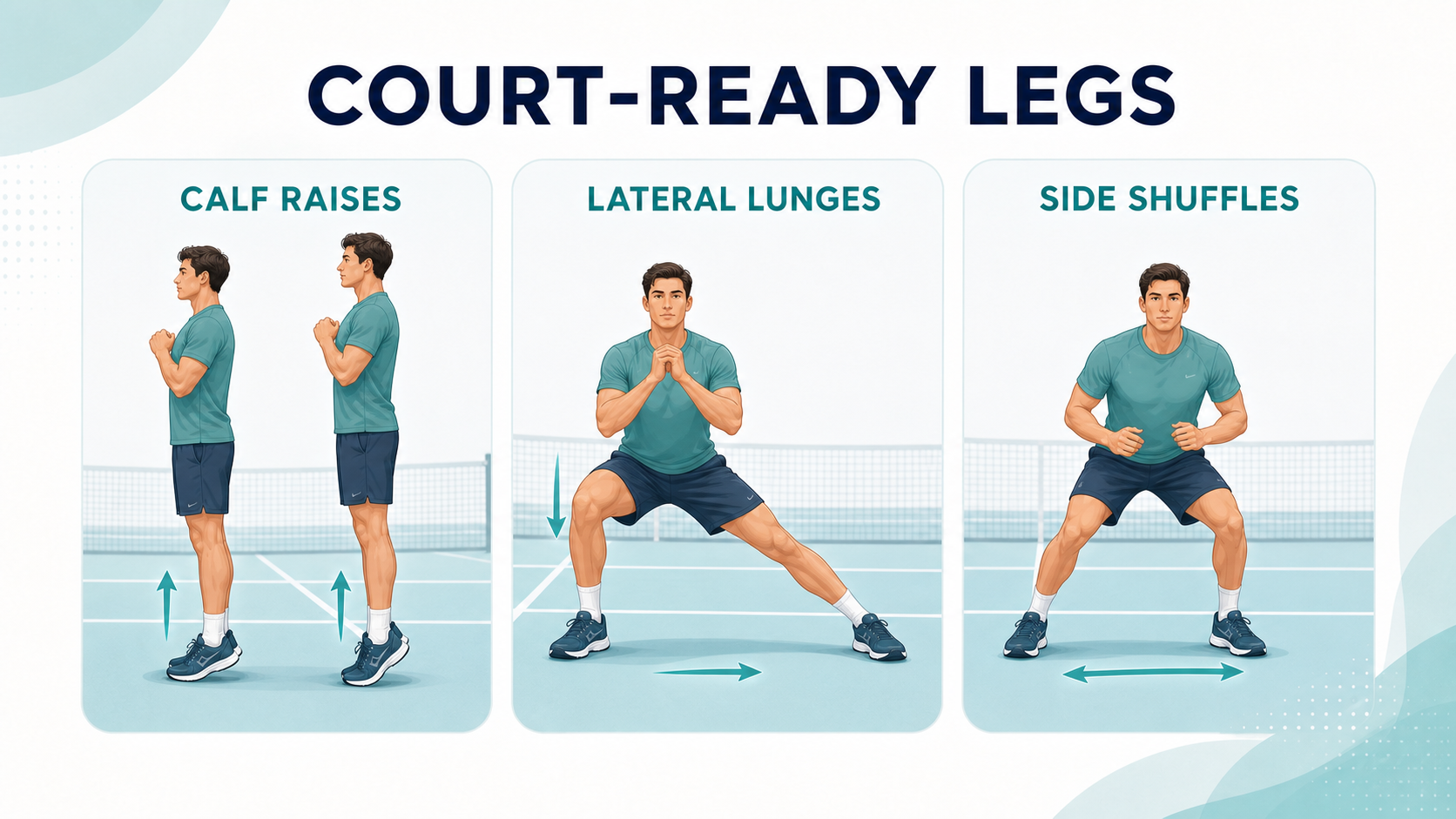
Keep the movements smaller at first. During a lateral lunge, the bending knee should track in the same general direction as the foot. During a side shuffle, stay balanced and avoid crossing the feet. You are rehearsing control, not trying to cover the entire court at full speed.
If one knee repeatedly feels uncomfortable, there may be more to assess than the knee alone. Our article about why knee pain is not always a knee problem explains how the foot, ankle, hip, and trunk can change what the knee experiences.
Prepare your shoulders, trunk, and paddle arm
The paddle is light, but repeated swings still depend on the shoulder blade, upper back, trunk, elbow, wrist, and grip. If the trunk does not rotate well, the arm may try to create too much of the motion by itself.
Begin with relaxed shoulder circles and easy trunk turns. Then hold the paddle and rehearse forehands and backhands at about half speed. Keep the grip lighter than it would be during a hard shot. A tight grip can make the forearm work harder before play has even started.
The same whole-body principle applies to overhead shots. Our guide to shoulder mobility during a tennis serve is written for tennis players, but its explanation of hip turn, upper-back motion, shoulder blade control, and timing also helps illustrate why the arm should not work alone.
Should you hold long stretches before playing? Usually, controlled dynamic movement is a better fit immediately before pickleball. If a brief static stretch helps a specific restriction, follow it with movement and easy practice swings before playing hard.
Warm up your shots in the right order
Once the body is moving comfortably, use the ball to build timing. Start close to the net with soft dinks. Progress to easy volleys, then move back and rehearse serves and returns. The pace should build gradually.
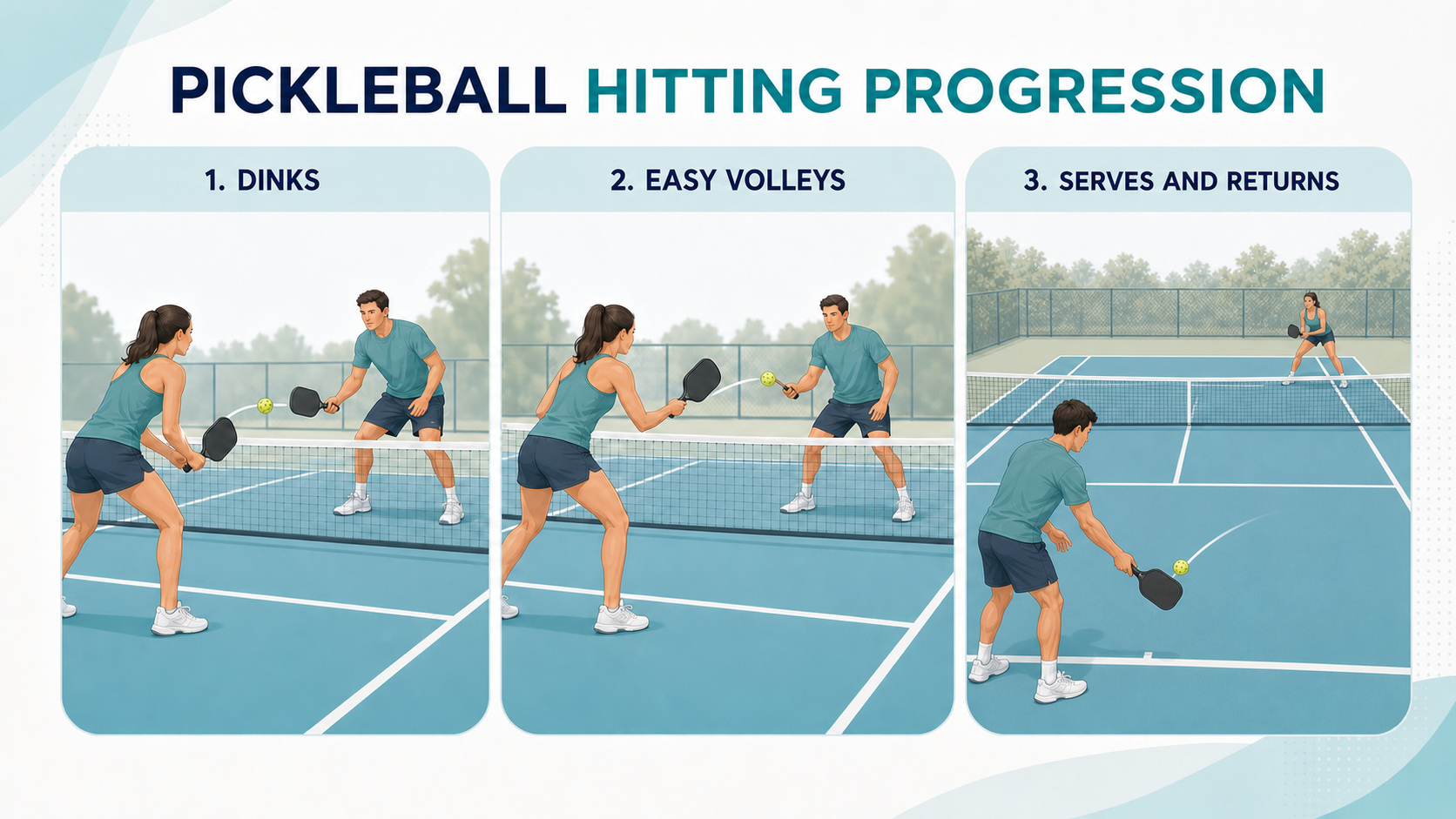
- Dinks: Find your balance, paddle angle, and soft touch.
- Easy volleys: Keep the exchanges controlled and focus on a stable ready position.
- Serves and returns: Start below full effort and practice getting balanced after the shot.
- Overheads: Add them last and increase the reach and pace gradually.
This progression gives the eyes, hands, feet, and paddle time to coordinate. It also lets you notice whether a certain swing or direction feels unusual before the score matters.
Common pickleball warm-up mistakes
- Starting with the hardest shot: A full-power overhead or deep reach should not be the first movement of the day.
- Only stretching: Holding positions does not rehearse the quick steps and reactions used in pickleball.
- Ignoring the feet: The lower body has to start, stop, and change direction on nearly every point.
- Warming up only the dominant arm: Trunk rotation, balance, and the non-paddle arm also help organize movement.
- Making the warm-up exhausting: Preparation should raise readiness without draining energy needed for play.
- Using running shoes for repeated side movement: The USA Pickleball safety guidance recommends court shoes suited to side-to-side movement.
Warm up wisely in South Florida heat
Warm weather does not eliminate the need to warm up. The air may be hot, but your joints, coordination, and movement patterns still benefit from a gradual start. Heat also adds a separate challenge.
On hot or humid days, arrive with water, use shade when available, and begin at a lower intensity. Early morning or later-day play may feel more manageable than the hottest part of the afternoon.
The CDC guidance for athletes recommends starting slowly, pacing activity, drinking more water than usual, and stopping if you feel faint or weak. Heat symptoms are not something to push through for one more game.
When to stop and get advice
A warm-up may make ordinary stiffness feel easier, but it should not be used to cover up sharp pain or instability. Stop if you feel sudden pain, new swelling, repeated joint pinching, numbness, tingling, dizziness, chest discomfort, or unusual weakness.
Recurring elbow, shoulder, knee, calf, or back symptoms may need more than a longer warm-up. Physical therapy can assess mobility, strength, balance, coordination, and how your weekly playing load has changed. The goal is to understand the pattern, not simply tell you to stop playing.
FAQs
About eight to ten minutes works well for many recreational players. You may need longer after sitting, on a stiff morning, when returning from a break, or before competitive play.
Use dynamic movements before play, such as ankle rocks, lateral lunges, arm circles, and controlled trunk turns. Longer static stretches are usually better saved for after play or a separate flexibility session.
Yes. Casual games still include quick reactions, side steps, reaches, and sudden stops. The warm-up can be brief, but your body still benefits from a gradual start.
Start with small arm circles, shoulder blade movement, gentle trunk turns, and slow shadow swings. Increase the range and speed gradually without forcing an overhead position.
Reduce the range or stop the movement. Sharp pain, instability, swelling, numbness, tingling, or symptoms that keep returning should be assessed instead of pushed through.
Keep reading
- How your shoulder mobility affects your tennis serve
- Why knee pain is not always a knee problem
- Why your traps always feel tight, even after stretching
- Why heel pain is often worse in the morning
Prepare to play with more confidence
A useful pickleball warm-up should feel simple enough to repeat every time you play. Start easy, prepare the whole body, and finish by rehearsing the game. If pain or stiffness is changing how you move on court, you can book an appointment or contact Sophysio for a movement-focused assessment.
Sources
- USA Pickleball, Health and Safety Hub
- American Academy of Orthopaedic Surgeons review of pickleball injuries
- CDC, Heat and Athletes