
 Services
 Conditions We Treat
 Contact

Shoulder mobility can change how your tennis serve feels, how much power you can create, and how much stress your arm absorbs. If your shoulder, upper back, or hips cannot move well together, the serve may start to feel tight, forced, or painful. That is why athletes at any level, from recreational to professional, may benefit from sports rehabilitation that looks at the whole movement, not just the shoulder.
A tennis serve is not only an arm motion. It is a coordinated movement that starts from the ground, travels through the legs and hips, rotates through the trunk, and finishes through the shoulder, elbow, wrist, and racquet. When one part of that chain is limited, the shoulder often has to do extra work.
In this article
- Why the tennis serve is a full-body movement
- How shoulder mobility affects your tennis serve
- Common mobility limits tennis players feel
- A simple pre-serve mobility warmup
- When shoulder stiffness or pain needs attention
Why the tennis serve is a full-body movement
Players often describe a serve problem as a shoulder issue because that is where they feel it. But the shoulder is usually the final link in a longer chain. Your legs create drive, your hips and trunk rotate, your shoulder blade positions the arm, and your rotator cuff helps control the shoulder as the racquet accelerates.

If your hips are stiff, your trunk rotation is limited, or your shoulder blade is not moving well, your arm may try to make up the difference. That can lead to a serve that feels late, rushed, or heavy. Over time, this can contribute to shoulder irritation, elbow strain, or wrist discomfort.
How shoulder mobility affects your tennis serve
During a serve, the shoulder has to move into a position that combines elevation, rotation, and control. If that motion is limited, you may arch your lower back more, push the elbow too far behind you, change your toss, or force the racquet drop. The serve may still go in, but your body pays for it.
Mobility is not just flexibility. It also includes control. A player may have enough passive motion when lying on a table, but still struggle to use that motion during a fast serve. That is why a good tennis shoulder assessment should look at range of motion, strength, timing, shoulder blade movement, and how the serve pattern looks in real life.
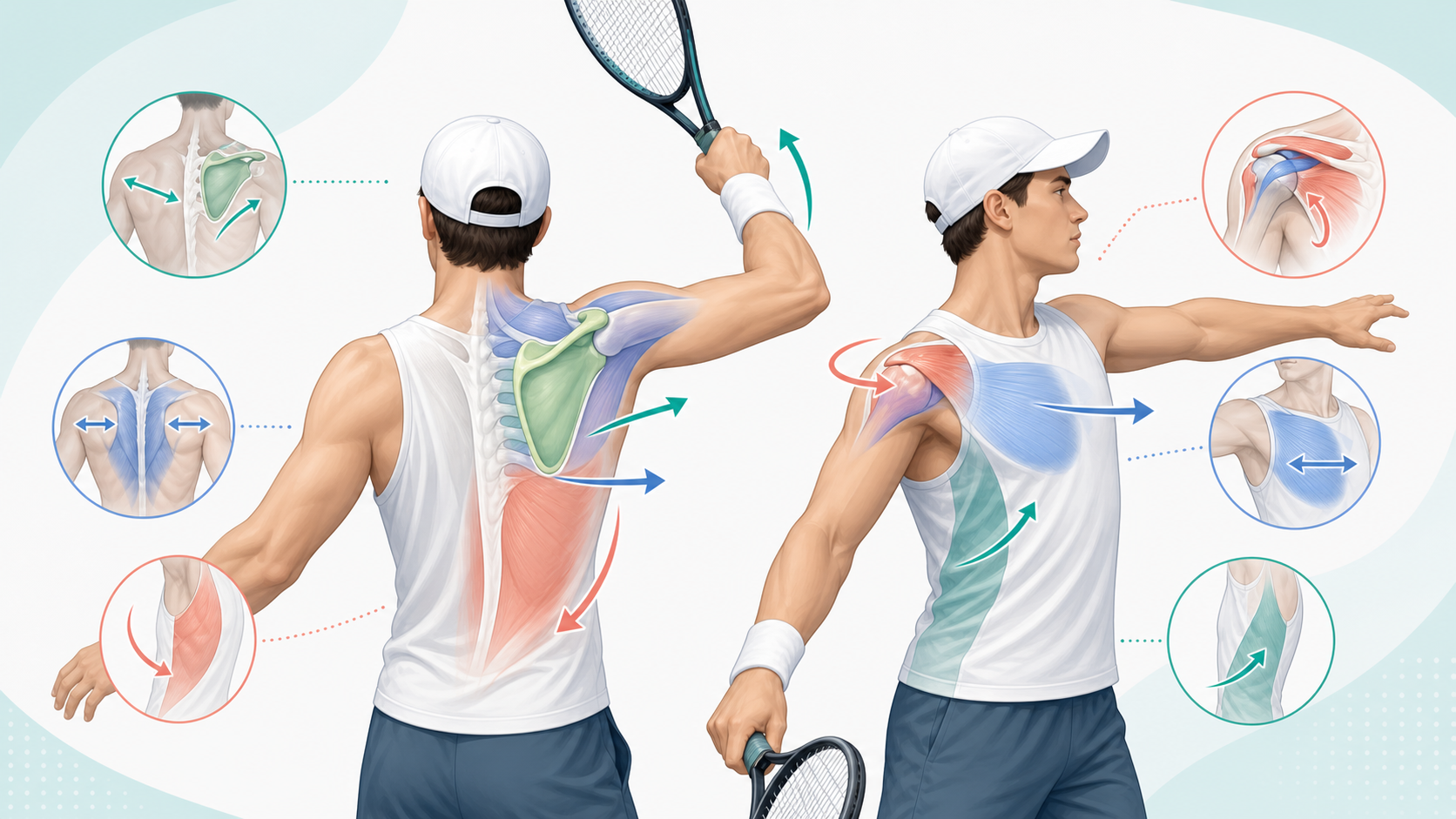
Research on tennis shoulder injuries has long pointed to the shoulder working as part of a kinetic chain rather than an isolated joint. The shoulder needs support from the trunk, scapula, and rotator cuff to handle repeated serving loads. Sources such as PubMed on tennis shoulder injuries, NCBI on rotator cuff injury, and AAOS rotator cuff information all support the idea that shoulder symptoms deserve a complete look at motion, strength, and load.
Common mobility limits tennis players feel
Some players feel tight in the front of the shoulder. Others feel pinching at the top of the shoulder, stiffness through the upper back, or fatigue around the shoulder blade. These sensations can come from different causes, so guessing is not always helpful.
- Limited upper back rotation. The player may compensate by arching the lower back or overreaching with the arm.
- Stiff chest or lat muscles. The racquet drop may feel restricted, and the shoulder may feel tight in the front.
- Poor shoulder blade control. The arm may feel unstable or heavy late in matches.
- Rotator cuff weakness or fatigue. The shoulder may feel fine early, then ache after repeated serves.
- Hip or trunk limitations. The shoulder may take extra load because the body is not rotating efficiently.
These limits can also affect the elbow. If the shoulder and trunk do not share the workload, the elbow and wrist may absorb more stress. That is one reason a player with recurring elbow pain may also need shoulder and trunk work, not just local elbow care. This connects naturally with tennis elbow, rotator cuff injuries, and shoulder impingement.
A simple pre-serve mobility warmup
A warmup does not have to be long to be useful. The goal is to prepare the shoulder, trunk, and legs for serving. Before you serve hard, your body should experience rotation, shoulder blade motion, light cuff activation, and a few easy practice serves.
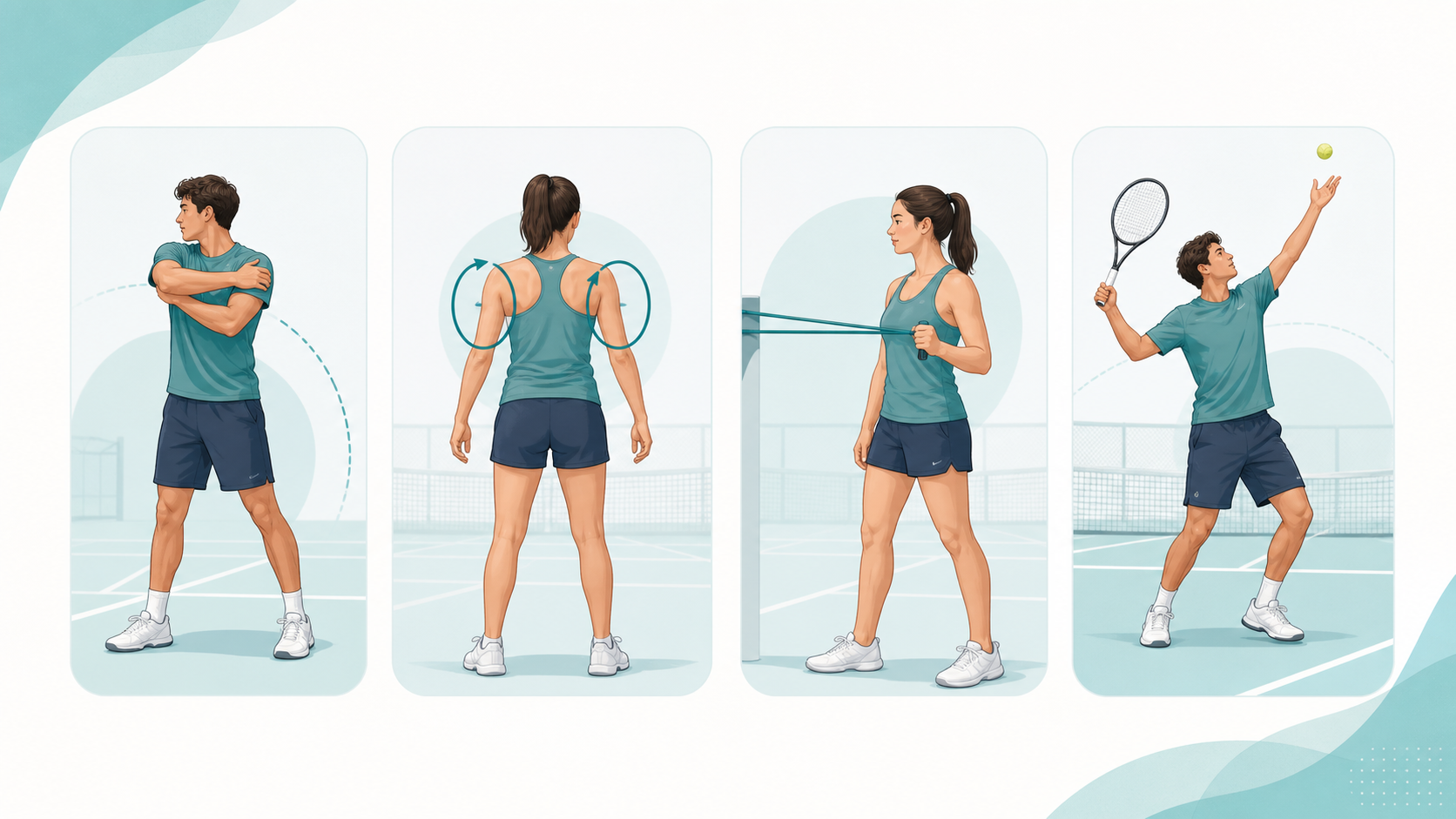
- Start with trunk rotation. Turn gently side to side to wake up the upper back and hips.
- Move the shoulder blades. Use slow shoulder blade circles or controlled arm circles.
- Add light resistance. Gentle external rotation or band-style movement can help prepare the rotator cuff.
- Build the serve gradually. Start with easy practice serves before full-speed serves.
When shoulder stiffness or pain needs attention
Some mild stiffness after a long match may settle with rest and normal recovery. But pain that returns every time you serve, pain that changes your motion, or pain that lingers into the next day should not be ignored.
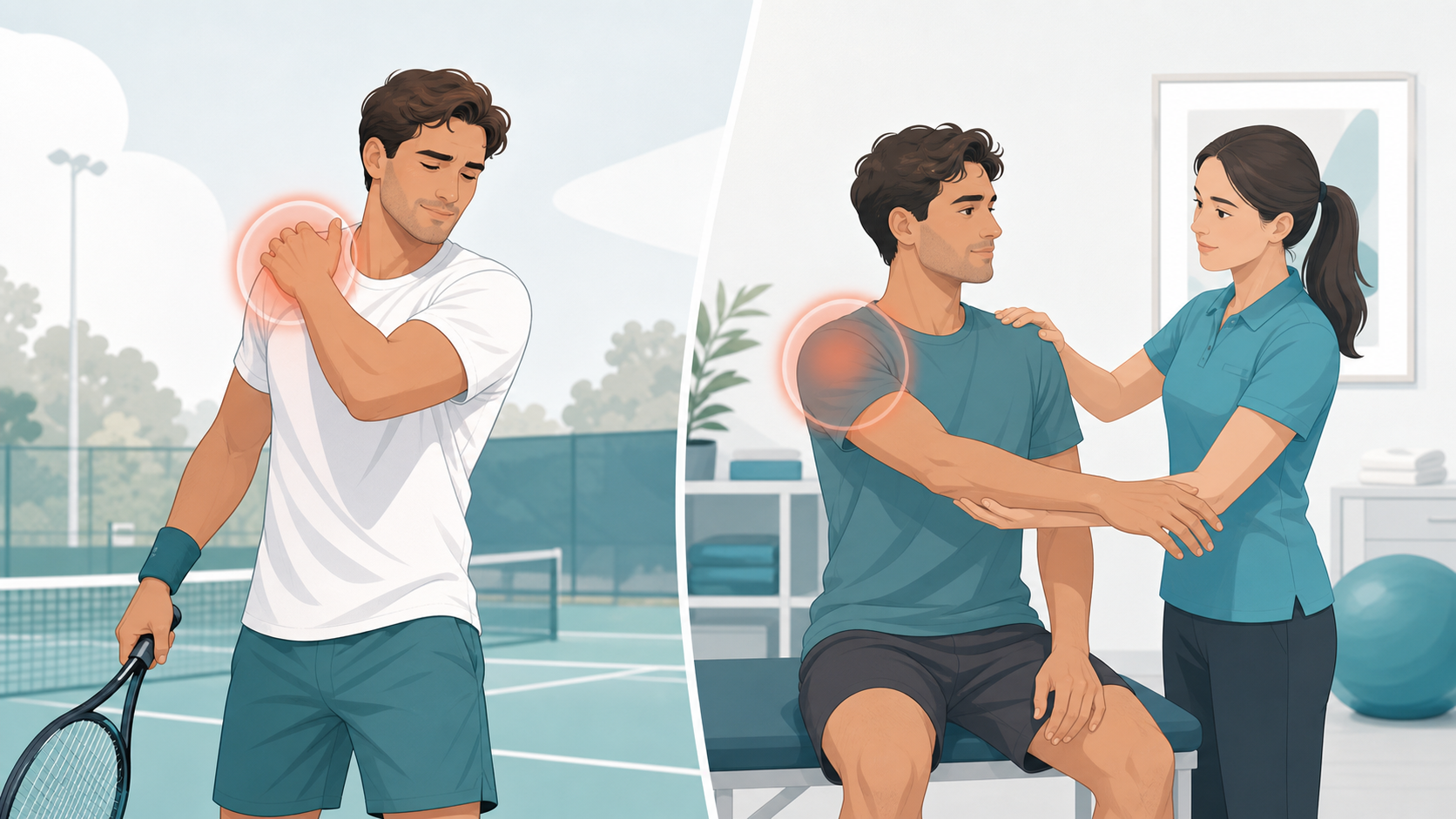
It is also worth getting checked if you feel weakness, clicking with pain, loss of serve speed, pain at night, or pain that spreads into the arm. A physical therapist can assess shoulder mobility, rotator cuff strength, shoulder blade control, trunk rotation, hip movement, and serve mechanics. That is often more useful than simply resting until symptoms calm down and then returning to the same pattern.
How physical therapy can help tennis players serve better
For tennis players, the goal is not only to reduce pain. The goal is to restore a serve pattern that feels strong, smooth, and repeatable. A plan may include shoulder mobility, upper-back mobility, rotator cuff strengthening, hip and trunk work, progressive serving volume, and return-to-play guidance.
At Sophysio, physical therapy and sports-focused rehab can help connect the dots between your symptoms and your movement. If you play regularly, year-round tennis means your shoulder may not get much downtime. A smart plan can help you keep playing while reducing the chance that a small issue becomes a bigger one.
FAQs
Yes. Limited shoulder, upper back, or trunk mobility can make the serve feel forced and may increase stress on the shoulder, elbow, or wrist.
The serve places the shoulder in a fast overhead position. If mobility, strength, timing, or shoulder blade control is limited, serving may expose the problem even when groundstrokes feel fine.
If pain is sharp, worsening, changing your serve, or lingering after play, it is smart to reduce serving volume and get assessed. Mild short-term soreness is different from recurring pain.
Sometimes. If the shoulder and trunk do not share the workload well, the elbow can take more stress. That is why recurring elbow pain often deserves a full movement-chain assessment.
Physical therapy can help improve the mobility, strength, and control that support better serve mechanics. It does not replace coaching, but it can help your body move better for the serve.
Keep reading
- Why Do I Feel Stiff After Sitting Too Long?
- Why heel pain is often worse in the morning
- Sports Rehabilitation
If shoulder tightness or serve pain is keeping you from playing comfortably, book an appointment with Sophysio or contact our team to ask whether a sports rehab assessment is right for you.
Sources
- PubMed: Shoulder injuries in tennis players
- NCBI Bookshelf: Rotator cuff injury
- AAOS OrthoInfo: Rotator cuff tears